
Angel Aligner vs Invisalign: An Evidence-Based Comparison
Two clear aligner systems, two very different histories. One has treated millions of patients and anchors most of the published literature. The other arrived in the United States recently with two decades of international data and some genuinely clever engineering. Here is an honest look at how they differ, and why the difference matters less than you might expect.
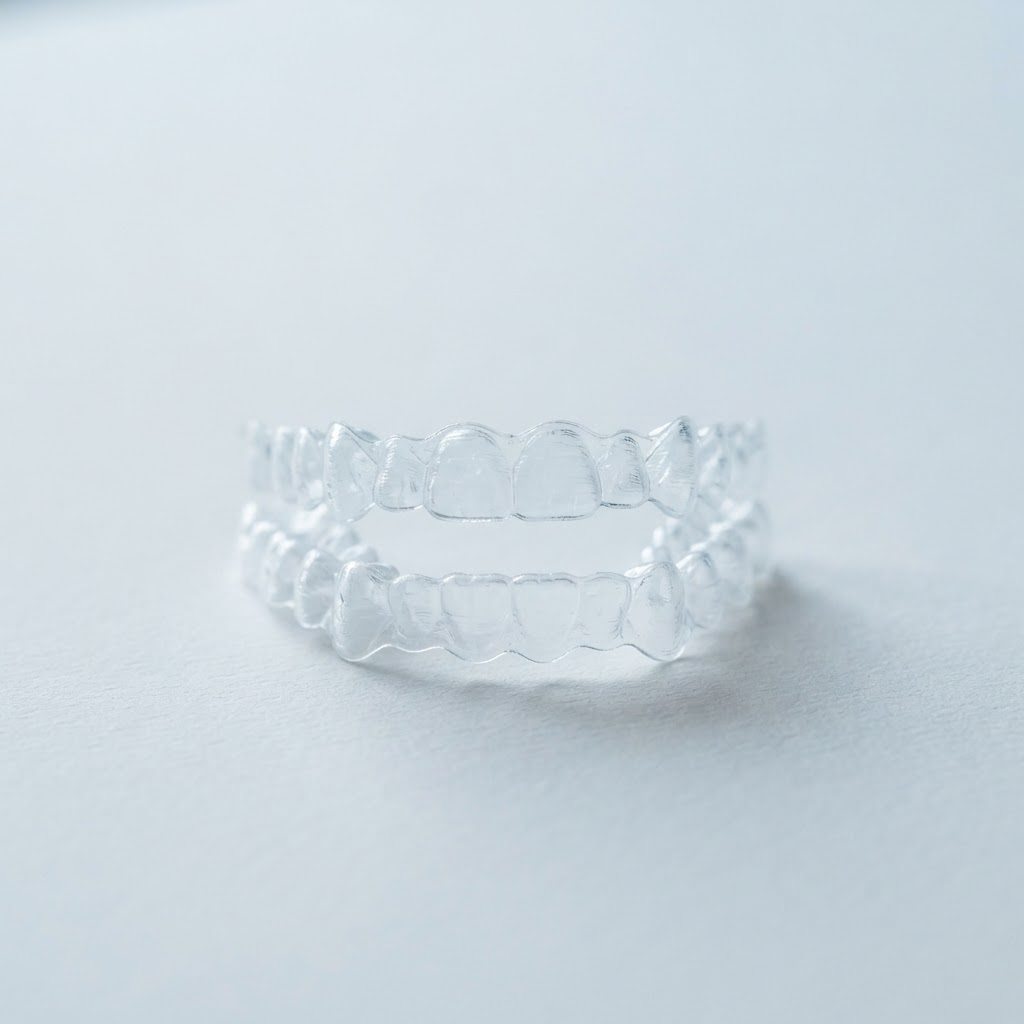
What both systems have in common
Before the differences, it is worth being clear about how much these two systems share, because it is most of what actually matters to a patient.
Both are sequential aligner systems: a series of clear, removable, custom-made trays, each shaped slightly differently from the last, worn in order so that teeth move a fraction of a millimetre at a time. Both are regulated by the FDA under the same device classification and require a prescription from a licensed dentist or orthodontist.210
Both also rely on the same clinical fundamentals:
- A 3D digital scan instead of putty impressions, used to build a virtual model of your teeth.6
- Doctor-directed digital planning, where your orthodontist reviews and adjusts a simulated tooth-by-tooth movement plan before anything is manufactured.46
- Composite attachments: small tooth-coloured bumps bonded to teeth to give the aligner something to push and pull against for rotations, extrusions, and other hard movements.
- 20 to 22 hours of daily wear. Both systems only move teeth while they are in your mouth. Compliance is the single largest variable in aligner treatment, and no brand can compensate for trays left in a drawer.
- Lifelong retention. Both require retainers afterward to hold the result.61
Side-by-side comparison
| Feature | Angel Aligner | Invisalign |
|---|---|---|
| Manufacturer | Angelalign Technology, founded 2003; publicly listed and operating in more than 60 countries5 | Align Technology, the company that commercialised clear aligners in the late 1990s6 |
| FDA status | 510(k) cleared as the Angel Align System, K171674, in January 20182 | Long-established FDA-cleared sequential aligner system10 |
| U.S. availability | Entered the U.S. market recently; provider network still expanding5 | Widely available nationwide with a large provider network6 |
| Tray material | Multilayer thermoplastic with a TPEE-based elastomer layer, engineered for sustained gentle force1 | SmartTrack, a proprietary multilayer thermoplastic developed to improve on earlier single-layer material6 |
| Planning software | iOrtho, with integrated cephalometric analysis and simulation4 | ClinCheck, paired with iTero scanning and outcome simulation6 |
| Signature complex-case feature | angelButton: an anchorage point moulded directly into the aligner for elastics, avoiding bonded buttons3 | Built-in bite-correction features and a large library of engineered attachments6 |
| Bite correction for growing patients | A6 Mandibular Advancement1 | Mandibular advancement using precision wings or occlusal blocks6 |
| Product range | Pro, Select, KiD, and Retainer lines1 | Comprehensive, Moderate, Lite, Express, First for children, and Vivera retainers6 |
| Published evidence base | Growing, with an expanding number of comparative studies | Largest of any aligner system, including systematic reviews spanning decades78 |
Angel Aligner: background and technology
Angel Aligner is made by Angelalign Technology, founded in 2003. Although the brand is new to most American patients, it is not a new company; it has been treating patients internationally for more than two decades and now operates across more than 60 countries.5 Its aligner system received FDA 510(k) clearance in January 2018 as the Angel Align System, and it began a serious push into the United States market afterward.25
The angelButton
This is Angel Aligner’s most distinctive contribution. In conventional aligner treatment, when the orthodontist needs to attach elastics (to correct a bite or pull a stubborn tooth), a small button must be bonded onto the tooth surface and the aligner cut around it. Buttons come loose, irritate the cheek, and the cut-outs weaken the tray. The angelButton is instead moulded directly into the aligner as a built-in anchorage point.3 Fewer bonded parts means fewer emergency visits and a cleaner way to apply the forces needed for more complex mechanics.
iOrtho planning and the product line
Angel Aligner plans cases in its iOrtho software, which combines cephalometric analysis with digital movement simulation.4 The product family covers interceptive treatment for children through complex adult work: Angel Aligner KiD for growing patients, Select for more limited cases, Pro for comprehensive treatment, plus a dedicated retainer.1 For growing patients with a retruded lower jaw, A6 Mandibular Advancement combines alignment with bite correction. The company reports its full solution manages more than 70 percent of complex cases.1
Invisalign: background and technology
Invisalign, made by Align Technology, is the system that created this category. It has been in clinical use since the late 1990s and has treated many millions of patients, which has two important consequences: the workflow is deeply refined, and nearly all long-term aligner research is Invisalign research.7
SmartTrack and gum-line trimming
Invisalign trays are made from SmartTrack, a multilayer thermoplastic the company developed specifically to deliver more predictable movement than its earlier single-layer material.6 Invisalign also trims each aligner to follow the patient’s individual gum line rather than using a straight cut, which the company describes as improving both comfort and appearance.6
The digital workflow
Treatment starts with an iTero scan, which produces the 3D model and can show you a preview of your projected result before you commit. Your orthodontist then builds the plan in ClinCheck, adjusting each tooth’s path and the attachment design. Progress is monitored at in-person visits, and treatment finishes with Vivera retainers made using the same technology as the aligners.6
Invisalign also offers tiered products, from Express for very minor corrections up to Comprehensive for full treatment, and Invisalign First designed for children’s developing arches.6 For Class II bite correction in growing patients, mandibular advancement is delivered either through precision wings or occlusal blocks integrated into the trays.
Material science and force delivery
This is where the marketing gets loudest and the practical difference gets smallest. Both companies moved from single-layer plastics to multilayer laminates for the same reason: a single-layer tray delivers a sharp initial force that decays quickly, while a laminate with an elastomeric core holds a gentler, more constant force across the wear period. Constant light force is what biology actually wants for efficient tooth movement.
Invisalign’s answer is SmartTrack.6 Angel Aligner’s is a multilayer construction built around a TPEE-type elastomer layer, and some of its protocols pair a more flexible tray with a stiffer one within the same stage: the soft tray to seat the movement comfortably, the firmer tray to express it fully.1
What the published research actually shows
Here is the part most comparison articles skip. Let us look at what the peer-reviewed literature says, including where aligners as a category fall short.
Aligners are effective, within limits
A systematic review in Progress in Orthodontics concluded that Invisalign is a viable alternative to fixed braces for correcting mild to moderate malocclusion in non-growing patients who do not need extractions, while noting it was less reliable for more demanding movements.7 That finding has aged well and broadly applies to the category, not just one brand.
Planned movement and achieved movement are not the same
A 2026 meta-analysis of transverse arch expansion with Invisalign in permanent teeth found pooled predictability of roughly 75 percent in the upper arch and 81 percent in the lower, meaning a meaningful share of the planned widening simply does not materialise. Accuracy was highest in the premolar regions and lowest at the molars, and expansion was achieved mainly by tipping crowns outward rather than by moving teeth bodily.8 A companion meta-analysis in growing patients reached similar conclusions.9
This is why experienced orthodontists deliberately build overcorrection into aligner plans and schedule refinement stages. It is a property of the technology, not a defect in a particular brand.
Brand-to-brand differences are modest
Comparative studies that put several aligner brands side by side on the same movement have generally found differences of only a few percentage points, with rankings shifting depending on which arch and which teeth are measured.14 In some published comparisons of expansion, Angel Aligner has scored marginally ahead of Invisalign; in Invisalign-specific meta-analyses using different methods and samples, the reported figures are higher still.814 These datasets are not directly comparable, and no honest reading of them supports declaring one brand clinically superior.
Handling complex cases
Modern aligners handle far more than mild crowding, but complex work depends on auxiliaries: attachments, elastics, temporary anchorage devices, and sometimes limited enamel reduction or extractions.
- Elastics and anchorage. Angel Aligner’s built-in angelButton is a genuine convenience advantage here, removing the need to bond separate buttons and cut the tray.3 Invisalign achieves the same mechanics with bonded buttons and precision cut-outs, which is well proven but involves more parts that can fail.
- Bite correction in teenagers. Both offer integrated mandibular advancement for growing Class II patients: A6 for Angel Aligner, precision wings or occlusal blocks for Invisalign.16
- Children and interceptive care. Angel Aligner KiD and Invisalign First both target developing arches.16 Either way, the AAO recommends a first orthodontic check no later than age 7, when growth can still be guided.12
- Where aligners are still the weaker choice. Significant skeletal discrepancies, large extraction-space closure, severely rotated or impacted teeth, and cases needing jaw surgery are often better served by fixed braces, sometimes combined with surgery. A specialist who offers both will tell you so rather than forcing a case into trays.13
Comfort, wear time, and appearance
Patients ask about this more than anything else, and the honest answer is that the two feel remarkably similar. Both are thin, clear, and removable. Both cause mild pressure or tenderness for a day or two when you switch to a new tray, a sign the aligner is working. Both require 20 to 22 hours of daily wear, and both must be removed to eat and to drink anything other than water.
On appearance, Invisalign’s gum-line trimming is a real and visible refinement.6 Beyond that, visibility depends far more on your attachments (how many, how large, and where) than on the tray brand. Staining is almost entirely a behavioural issue: coffee, tea, and red wine sipped through aligners will discolour any material.
Cost and insurance
What you actually pay is driven by your case, not the brand. Invisalign itself notes that its cost is generally comparable to braces and depends on case complexity and the number of aligners required.6 The variables that move your fee are:
- Case complexity and expected treatment length
- The number of aligner stages, plus any refinement stages
- How many in-person visits and how much monitoring are included
- Whether records, retainers, and post-treatment follow-up are bundled into the quoted fee
- Your orthodontic insurance benefit, which is often capped as a lifetime maximum rather than an annual one
Which system is right for you
Rather than crowning a winner, here is how the decision usually breaks down in practice.
Reasons Invisalign may be the better fit
- You want the system with the longest track record and the deepest published evidence base.
- Your case involves movements where the widest body of documented experience is reassuring.
- You value the gum-line trimming and the mature app and monitoring ecosystem.
- You may relocate, and want the largest possible network of providers able to continue your care.
Reasons Angel Aligner may be the better fit
- Your plan calls for significant elastic mechanics, where the built-in angelButton reduces bonded parts and emergency visits.3
- Your orthodontist is fluent in the iOrtho workflow and confident planning your case in it.
- You are drawn to the two-tray-per-stage protocol for comfort during larger movements.
Reasons neither may be right
If you have a significant skeletal discrepancy, need substantial extraction-space closure, or have teeth that need to be uprighted or brought down from an impacted position, fixed braces may deliver a better and more stable result. For a genuinely narrow upper jaw in a growing child, a palatal expander is usually the correct appliance. The research on aligner-driven expansion is a good reminder of why.89
What matters more than the brand
If you take one thing from this article, take this: the published gap between major aligner brands is a few percentage points, while the gap between a well-executed case and a poorly executed one is the difference between a healthy, stable bite and years of frustration.
These are the factors that genuinely determine your outcome:
- Accurate diagnosis. A proper in-person examination with records and imaging, before any trays are ordered. The AAO is blunt about the risks of skipping this.11
- Specialist training. Orthodontists complete years of additional education beyond dental school specifically in moving teeth and guiding growth.13
- Thoughtful planning. Realistic staging, sensible overcorrection where the evidence says movement will fall short, and well-designed attachments.8
- Real monitoring. In-person visits where a clinician checks that teeth are actually tracking the plan and intervenes early when they are not.10
- Your wear time. The most powerful variable in the entire process, and the one only you control.
- A retention plan. Because finishing treatment and keeping the result are two different achievements.6
Frequently asked questions
Is Angel Aligner as good as Invisalign?
What determines the cost of treatment?
Which one is more comfortable?
Can either system treat severe crowding or a bad bite?
Do clear aligners work as well as braces for widening a narrow arch?
Can I get either brand without seeing an orthodontist in person?
Will I need a retainer afterward?
Does Reston Orthodontics offer both?
References
Every claim above links to its source. Peer-reviewed studies are listed with their journal and PubMed identifier.
- Angel Aligner. Official product portfolio and clinical innovations, including iOrtho treatment planning, the angelButton, and A6 Mandibular Advancement.angelaligner.com
- U.S. Food and Drug Administration. 510(k) Premarket Notification K171674, “Angel Align System,” sequential aligner (regulation 872.5470). Decision date January 19, 2018; decision: substantially equivalent.accessdata.fda.gov: 510(k) K171674
- Angel Aligner. angelButton: a built-in anchorage point moulded into the aligner for elastics and complex tooth movements.angelaligner.com: angelButton
- Angel Aligner. iOrtho digital treatment planning software, including cephalometric analysis and digital simulation.angelaligner.com: iOrtho
- Angel Aligner. Company background on its two decades of global treatment data and its expanding United States footprint.angelaligner.com: U.S. expansion
- Align Technology. How Invisalign treatment works: SmartTrack material, iTero scanning, ClinCheck treatment planning, Vivera retainers, gum-line trimming, and cost guidance.invisalign.com: How Invisalign works
- Papadimitriou A, Mousoulea S, Gkantidis N, Kloukos D. Clinical effectiveness of Invisalign orthodontic treatment: a systematic review. Progress in Orthodontics. 2018;19(1):37. PMID 30264270.PubMed: PMID 30264270
- Serafin M, Boccalari E, Calò M, Zecca PA, Caprioglio A. Predicting transversal dental arch expansion outcomes with Invisalign aligners in permanent dentition: a systematic review and meta-analysis. Progress in Orthodontics. 2026;27(1):14. PMID 41910902.PubMed: PMID 41910902
- Fonseca Planells L, Bellot-Arcís C, Montiel-Company JM, Paredes-Gallardo V, Zamora-Martínez N. Effectiveness of clear aligners for maxillary expansion in growing patients: a systematic review and meta-analysis. Progress in Orthodontics. 2026;27(1):19. PMID 42060239.PubMed: PMID 42060239
- American Association of Orthodontists. Aligners: what they are and how they are used in orthodontic treatment.aaoinfo.org: Aligners
- American Association of Orthodontists. Considering at-home orthodontics? Guidance on the risks of treatment without in-person diagnosis and supervision.aaoinfo.org: At-home orthodontics
- American Association of Orthodontists. Child orthodontics: recommendation that children have an orthodontic check-up no later than age 7.aaoinfo.org: Child orthodontics
- American Association of Orthodontists. How to choose the right orthodontist: why specialist training and the full range of treatment tools matter more than any single product.aaoinfo.org: Choosing an orthodontist
- Progress in Orthodontics. Open-access article archive, including comparative studies of expansion predictability across clear aligner brands and studies comparing aligner systems built from different materials.progressinorthodontics.springeropen.com

Your smile starts here
Ready to feel great about your smile?
Meet the team, tour our office, and get a personalized plan. No pressure, just possibilities.